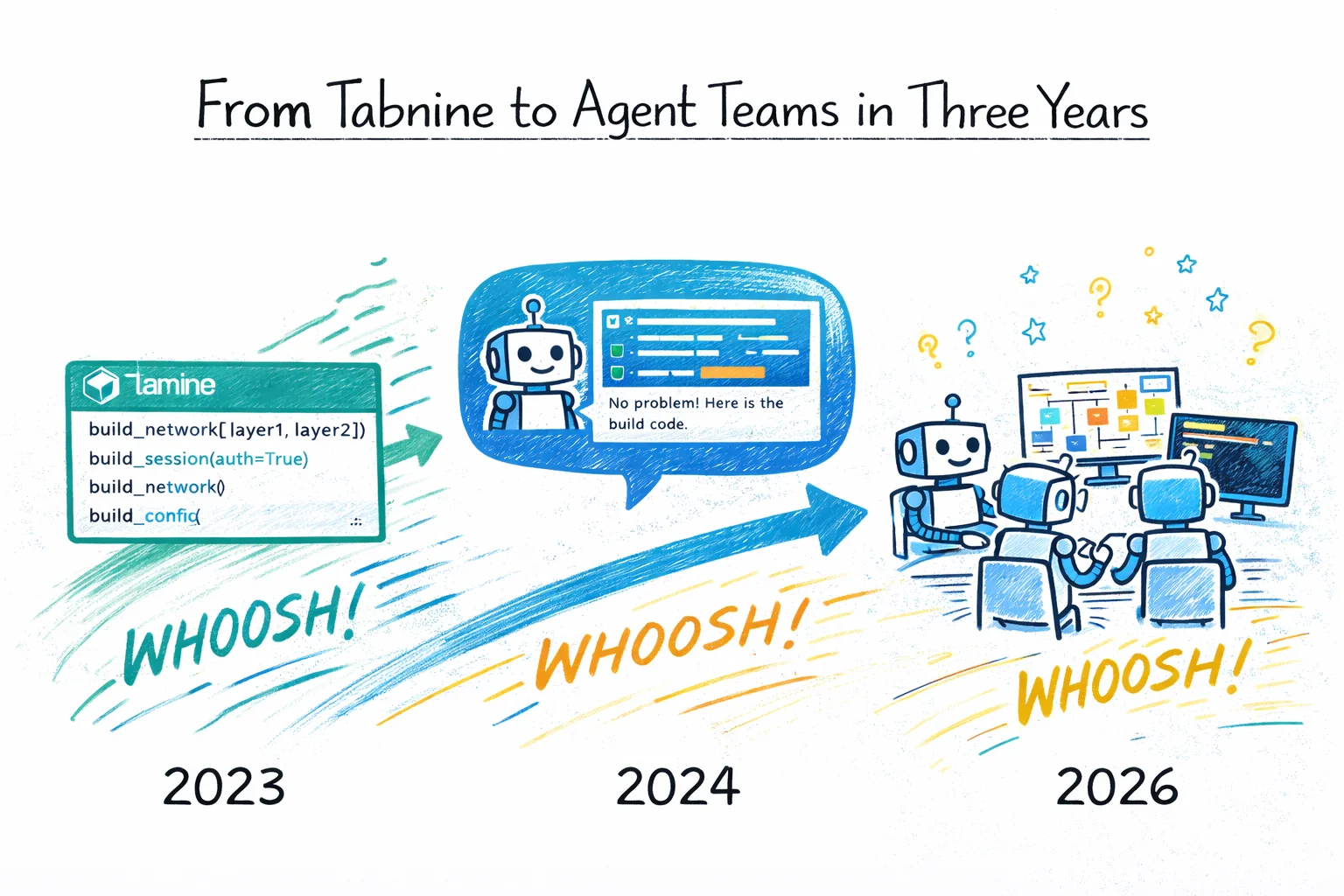
In April 2023, we discovered Tabnine. It was an AI code completion tool - you'd be typing a function and it would suggest the next few lines. We thought it was impressive. We installed it. We played with it for a bit. We moved on.
In February 2026 - not even three years later - I watched a video of Claude Code running autonomous agent teams. Multiple AI agents, coordinating with each other, splitting a development task into subtasks, implementing them in parallel, reviewing each other's work, and producing a finished feature.
Three years. From autocomplete to autonomous teams. I don't think most people appreciate how fast this moved, because when you're living through it, each step feels incremental. It's only when you look at the full timeline that the pace becomes genuinely staggering.
2023: The Autocomplete Era
Tabnine was our first serious encounter with AI in the development workflow. It sat inside the IDE and suggested code completions. Sometimes they were good. Sometimes they were hilariously wrong. You'd be writing a database query and it would suggest code from a completely different context, like offering you directions to Birmingham when you asked for a sandwich.
But even the bad suggestions were interesting, because they showed you what was possible. The AI had read enough code to have opinions about what should come next. Those opinions were often wrong, but they were opinions nonetheless.
At this point, AI was a curiosity. A nice-to-have. You could take it or leave it, and most developers left it.
Late 2024: The Multi-Model Playground
By late 2024, we'd moved on to tools like TypingMind - a chat interface that let you use multiple AI models with your own API keys. This was a different kind of tool. It wasn't sitting inside the IDE suggesting completions. It was a separate workspace where you could have extended conversations with AI about code, architecture, strategy, anything.
The shift was subtle but important. AI went from "thing that finishes your sentences" to "thing you have conversations with." Instead of accepting or rejecting suggestions, you were explaining problems, discussing approaches, and iterating on solutions.
This was when AI started affecting how I thought about development, not just how I typed.
Mid-2025: AI as Development Partner
Claude Code launched and everything changed again. This wasn't a chatbot you copied code from. It was an AI that lived in your terminal, could read your files, understood your project structure, and could make changes directly to your codebase.
The workflow shifted from "ask AI, copy answer, paste into editor" to "describe what you want, review what the AI produces, iterate together." It was pair programming, except your partner had read every piece of documentation ever written and could type at several thousand words per minute.
Around this time, comparisons started appearing - Claude versus GPT, Sonnet versus Opus, different models for different tasks. The fact that we were comparison shopping between AI coding partners, rather than debating whether AI was useful at all, tells you how quickly the baseline had shifted.
Late 2025: The Tool Explosion
By the end of 2025, the ecosystem had exploded. Warp launched as an "agentic development environment" - a terminal that was AI-native from the ground up. Pieces offered "long-term memory for your whole workstream." Every development tool was either adding AI features or being replaced by an AI-native alternative.
More importantly, MCP - Model Context Protocol - emerged as a standard for connecting AI to external systems. I built MCP servers for our MongoDB databases, our project management tool, and Chrome. Suddenly the AI wasn't limited to what I told it - it could go and look at things itself. Read a database record. Check a task description. Inspect a web page.
This was when AI stopped being an assistant and started being an agent. The difference matters. An assistant waits for you to ask. An agent goes and does.
Early 2026: Autonomous Teams
And then, February 2026, agent teams. Multiple AI agents working together on a single task. A lead agent that breaks down the work. Specialist agents that handle implementation. Review agents that check the output. All coordinating autonomously, with a human overseeing the process rather than directing every step.
I watched the demo and thought about Tabnine three years earlier, suggesting the next line of a function. The distance between those two points is absurd. It's like watching the Wright brothers' first flight and then seeing the moon landing, except compressed into thirty-six months.
What Each Step Actually Felt Like
Here's the thing about living through exponential change: each step feels normal at the time.
Going from Tabnine to TypingMind felt like a natural progression. Going from TypingMind to Claude Code felt like a sensible upgrade. Going from Claude Code to MCP integrations felt like the obvious next step. Each transition was a manageable leap.
It's only when you stack them up that you realise you've gone from "the AI can finish my line of code" to "the AI can autonomously build features while I review its work" in the time it takes a university student to finish a degree.
That pace shows no sign of slowing down. If anything, each generation of tools arrives faster than the last. The gap between Tabnine and TypingMind was about eighteen months. The gap between Claude Code and agent teams was about six months.
What This Means for Developers
If you're a developer reading this in 2026, the tools you're using today will feel primitive within a year. That's not a criticism of today's tools - they're extraordinary. It's an observation about the pace of change.
The developers who will thrive are the ones who stay curious, keep experimenting with new tools, and - critically - maintain their fundamental skills. Every new tool in this timeline built on the one before it. Claude Code is only useful if you understand software architecture. Agent teams are only useful if you can evaluate their output. The tools get more powerful, but the human expertise that directs them becomes more important, not less.
I don't know what the next step looks like. Eighteen months ago, I couldn't have predicted agent teams. Whatever comes next will probably seem obvious in hindsight and impossible to imagine right now.
But I know I'll be there to try it. Because if three years of this timeline have taught me anything, it's that the most interesting tool is always the one you haven't seen yet.